
Conditions · Salt Lake City
Shoulder Pain Treatment
The shoulder is the most mobile joint in the body, which means it depends on everything around it behaving. We treat the whole system: cuff, shoulder blade, mid-back, and neck.
What it feels like
- Pinching at the top or front of the shoulder when reaching overhead
- A deep ache that shows up at night, lying on that side
- Weakness or pain when reaching behind you: seatbelt, back pocket, bra strap
- Clicking or grinding with movement
- Pain that arrived with a new season of golf, pickleball, swimming, or pressing
- Gradual loss of range that's starting to feel "frozen"
What's usually driving it
A shoulder blade that lost its rhythm
The shoulder blade is the launchpad for every arm movement. When it stops rotating and gliding properly, usually thanks to posture, a stiff mid-back, or old habits, the ball-and-socket joint runs out of room and the cuff gets pinched doing ordinary things.
A cuff that's irritated, not torn
Most shoulder pain in active adults is tendinopathy, a rotator cuff that's been asked to stabilize a poorly positioned joint for years. It's cranky, not broken, and it responds to smart loading better than to rest.
A stiff mid-back stealing motion
Overhead reach requires the thoracic spine to extend and rotate. When it won't, the shoulder and neck make up the difference. This is the most commonly missed driver of shoulder pain, and one of the most fixable.
The fix, step by step
- 1
We start by finding the real driver: cuff, blade mechanics, mid-back, neck referral, or (usually) a combination. The exam sorts it out; you'll understand exactly what's pinching and why.
- 2
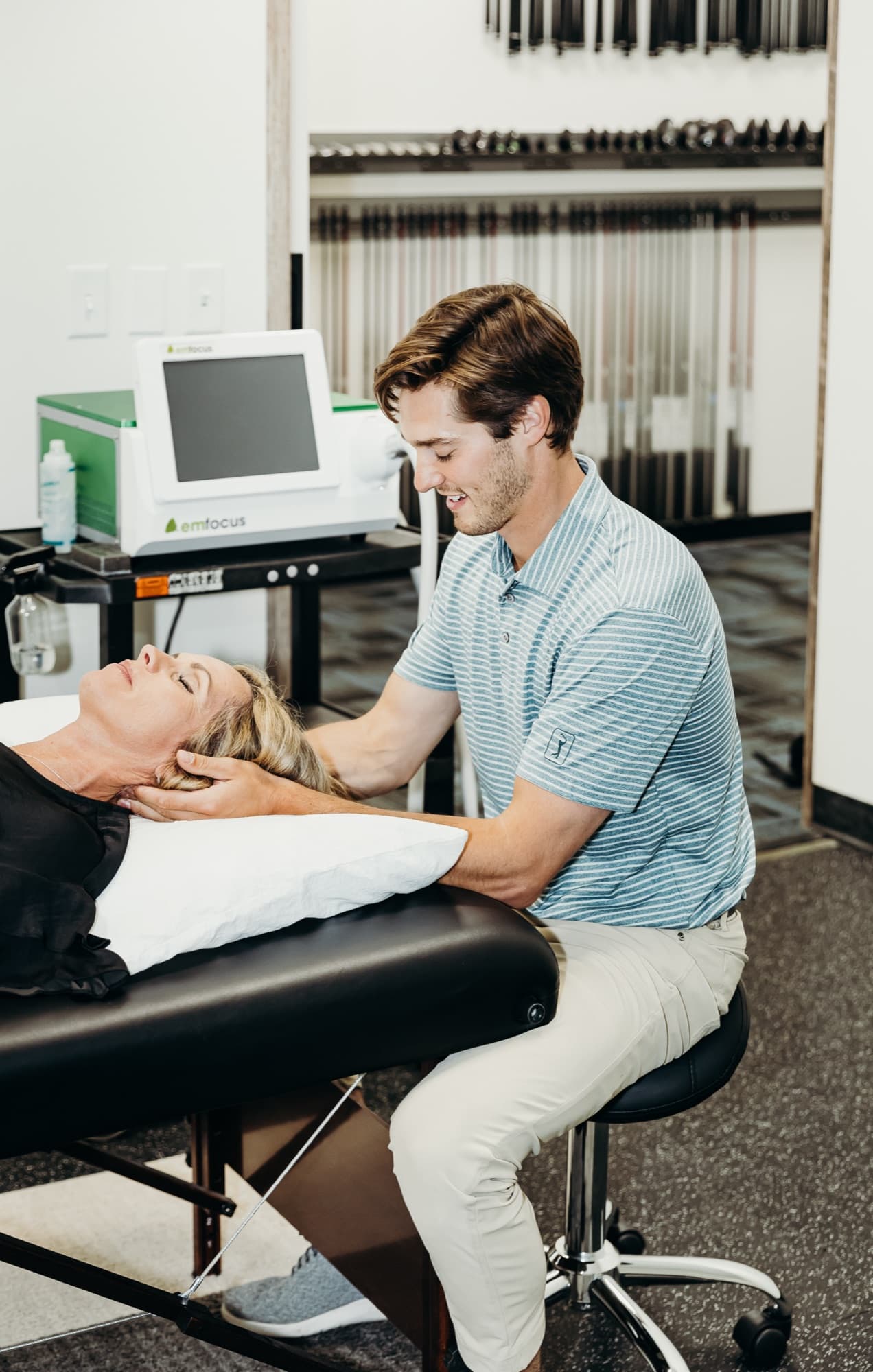
Hands-on care settles the irritated tissue: dry needling for the guarded cuff and upper trap, joint work for the stiff thoracic spine and shoulder capsule, shockwave for chronic calcific or degenerative tendon changes.
- 3
Then we rebuild: restoring shoulder-blade control, re-earning overhead range, and loading the cuff progressively until serves, presses, and swimming strokes feel strong again, with a maintenance routine to keep it that way.
Services we use for shoulder pain
When it's not a job for us
Shoulder pain after significant trauma, with visible deformity, with fever, or with progressive numbness and weakness down the arm warrants medical evaluation and possibly imaging first. Sudden complete loss of strength (can't lift the arm at all after an injury) suggests a full-thickness tear that deserves an orthopedic opinion. We'll help you get one quickly.
Shoulder Pain questions
Possibly, but partial-thickness cuff changes are nearly universal after 40 and often pain-free. What matters is whether your shoulder can be made strong and functional, and for the large majority the answer is yes, without surgery. Exam findings tell us when an orthopedic referral is the smarter path.
Done living with shoulder pain?
Start with a free discovery call: tell us what's going on, and we'll tell you honestly whether we're the right fit and what the fix looks like.