Recovery
Shockwave Therapy vs Chiropractic Care: Which Do You Need?
Patients ask this question all the time, usually framed as a competition: should I try shockwave therapy or chiropractic care? It's a reasonable question with a slightly sneaky answer. They aren't competing treatments. They solve different problems, and the injury you're carrying usually tells you exactly which one it needs. Often it's both.
Here's the clean way to think about it.
Chiropractic care treats motion problems
Joints are designed to move through specific ranges, and when they stop, through injury, posture, guarding, or plain disuse, the body compensates. Neighboring joints pick up extra motion they're not built for, muscles around the stiff segment tighten protectively, and pain shows up either at the stuck joint or at whichever neighbor is doing its overtime.
Chiropractic adjustment is a motion intervention: a specific, controlled input that restores movement to a restricted joint and gives the surrounding muscle guarding a reason to let go. It shines for stiff, achy backs and necks, hips that lost rotation, and the whole family of problems where the core issue is a segment that quit moving.
What adjustment doesn't do is repair tissue. If your problem is a degenerated tendon, adjusting the nearby joint may help the mechanics that overloaded it, but it won't rebuild the tendon itself.
Shockwave treats healing problems
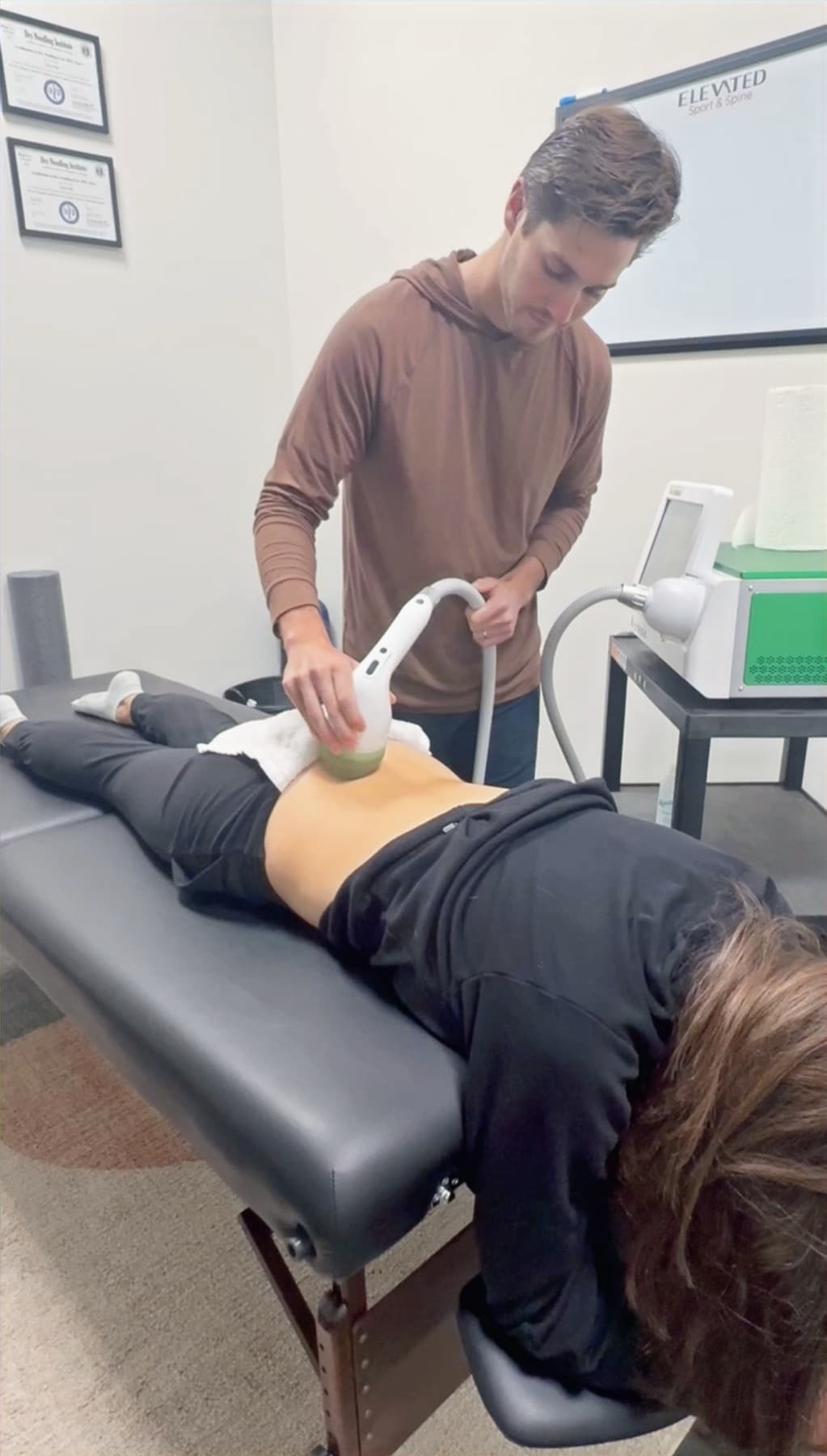
Shockwave therapy is a tissue intervention. It targets the chronic, degenerated soft tissue that has stopped trying to heal: plantar fascia, achilles, tennis elbow, patellar tendon, calcific rotator cuff. Focused acoustic waves restart the biological repair process: new blood vessel growth, increased repair-cell activity, and breakdown of the disorganized tissue that formed during failed healing.
What shockwave doesn't do is restore joint motion or fix the movement pattern that overloaded the tissue in the first place. Blast a tendon back to life while the mechanics that wrecked it stay unchanged, and you've scheduled a rematch.
A quick self-diagnosis guide
Neither of these replaces an actual assessment, but the patterns are fairly reliable:
- Stiffness that loosens with movement, aching near the spine or deep in a joint, pain that moves around: motion problem first; chiropractic care leads
- A specific spot on a tendon that hurts with use, has lasted more than three months, and shrugs off rest and ibuprofen: healing problem; shockwave leads
- Morning heel pain, mid-tendon achilles pain, outer elbow pain gripping a coffee cup: classic chronic tendinopathy; shockwave territory
- Pain that started after a joint "locked up," or restriction you can feel when you turn or bend: chiropractic territory
- An injury that's been through rest, PT, and massage and keeps returning: almost always both: a motion problem upstream feeding a tissue problem downstream
Why the combination usually wins
Take the most common story we see: outer elbow pain in a golfer or pickleball player. The tendon is genuinely degenerated: a healing problem, shockwave's job. But upstream, the wrist, shoulder, or thoracic spine lost motion months earlier, quietly redirecting load into that tendon with every swing. Treat only the tendon and the mechanics re-injure it. Treat only the mechanics and the degenerated tissue keeps aching.
This is why at Elevated Sport and Spine you don't actually have to choose. Every plan starts with an assessment that identifies both the tissue problem and the motion problem, and your one-hour visits have room for both tools, plus the movement retraining that keeps the fix permanent.
If you're weighing the two, the free discovery call exists for exactly this conversation: tell us the story of your injury, and we'll tell you honestly which tool, or combination, it's asking for.

Dr. Taylor Wolf
Owner & Chiropractor, Elevated Sport and Spine
TPI Certified (Level 1 + Medical Level 2), PRI trained, dry needling certified. One-hour, one-on-one sports chiropractic in Salt Lake City. About Dr. Wolf →